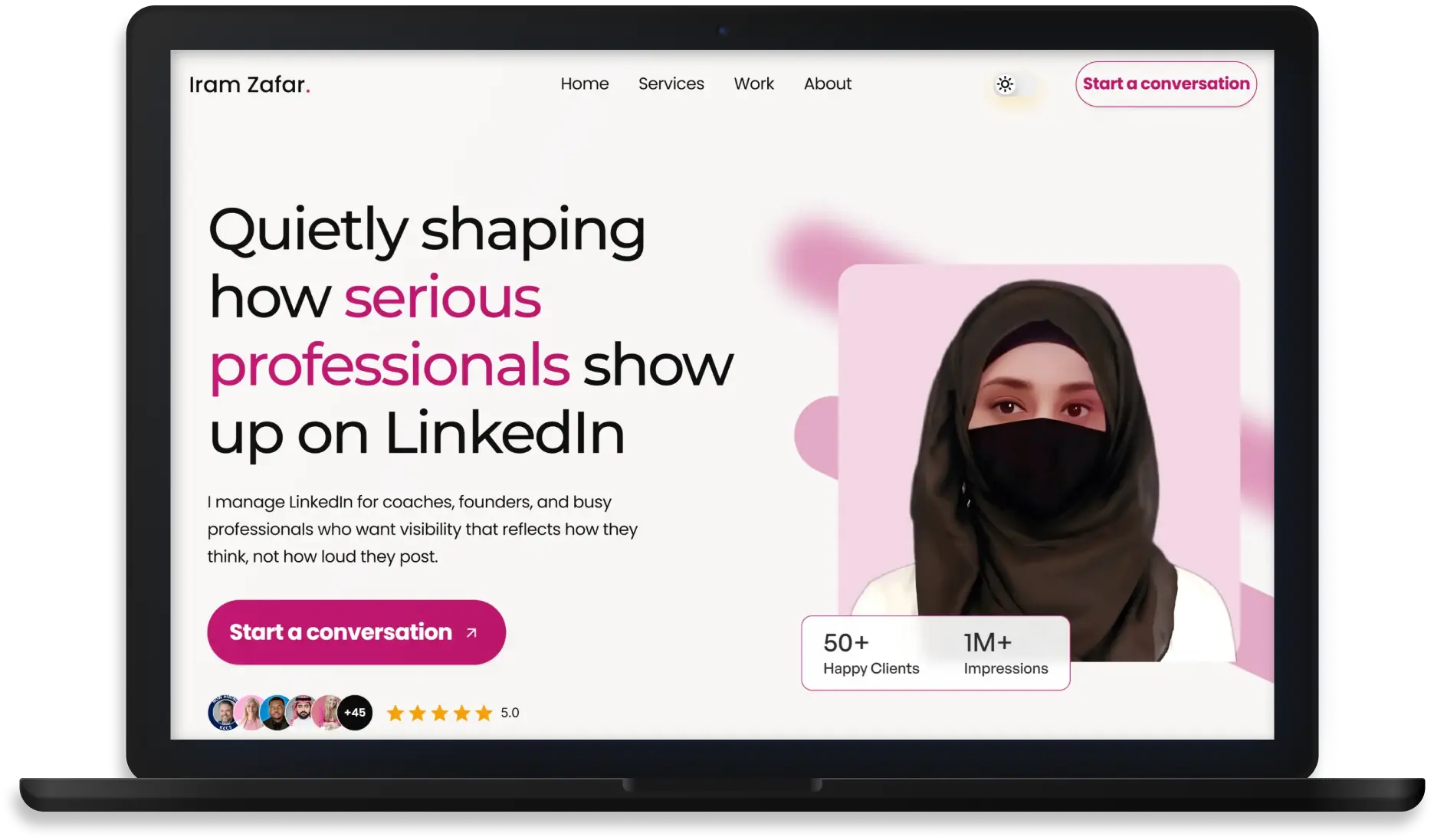
PROJECT
IramZafar
ROLE
Web design/Dev
The Challenge
This wasn’t a typical personal brand website.
The challenge was to design a site that:
Didn’t feel salesy or promotional
Didn’t rely on loud visuals or exaggerated claims
Reflected quiet, behind-the-scenes work
Attracted thoughtful clients, not volume
Communicated trust without explaining everything
Most websites in this space feel templated, noisy, or overly performative.
This one needed to feel considered.
The Strategy
I designed the site around one core idea:
The website should feel the way the work feels.
Key strategic decisions:
Positioning before visuals , clarity came first
Editorial hierarchy instead of marketing layouts
Minimal visual noise to support thinking
No aggressive CTAs or pressure patterns
Subtle motion used only to guide attention
Proof presented quietly, not theatrically
The structure follows a calm progression:
Context → Recognition → Understanding → Proof → Conversation
The Solution
A custom, positioning-first website built to act as a filter — not a funnel.
It includes:
A calm hero section that frames the work without selling
A recognition-first problem section that makes visitors feel understood
A behind-the-scenes process breakdown
Curated proof through screenshots and testimonials
A modular services structure for clarity without pressure
A soft, human CTA that invites conversation instead of pushing it
Every section was designed to reduce friction, not increase urgency.
The Outcome
A website that:
Feels aligned with the work itself
Builds trust before asking for action
Pre-qualifies the right type of clients
Encourages thoughtful inquiries, not impulsive ones
Acts as a long-term foundation, not a campaign asset
This site isn’t meant to convert everyone.
It’s meant to resonate with the right people.
Key Focus Areas
Positioning & Perception Design
Editorial UX Structure
Quiet Authority Systems
Trust-First Layout Decisions
Clarity Over Conversion Tactics
Tools & Stack
Framer (Design + Build)
Custom typography system
Light + dark mode color system
Editorial layout logic
Motion used for rhythm, not effect
Mobile-first layout decisions
Final Note
This project wasn’t about creating a “personal brand website.”
It was about designing a digital presence that feels accurate to the work, the thinking, and the people it’s meant for.